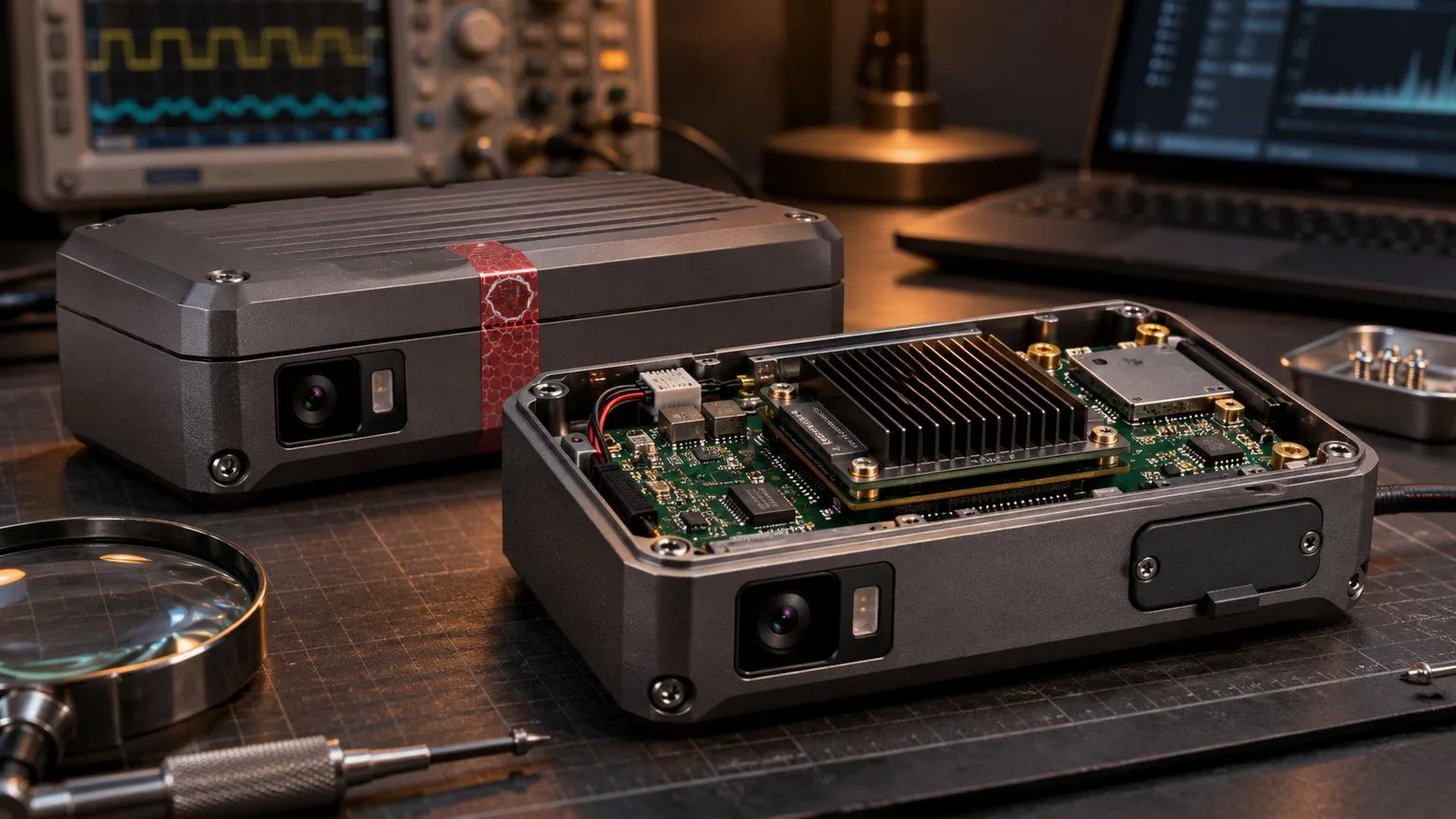
To secure edge AI devices, treat the model as executable product state rather than a passive data file. It changes what the device accepts, what it decides, what it stores and sometimes what it physically does. The security boundary must therefore cover the model artifact, inference runtime, sensor path, update path, decision policy and retained data together. Protecting only the network connection leaves the most consequential parts of on-device inference outside the threat model.
What a model adds to the attack surface
A conventional connected device already has firmware, credentials, interfaces and a service relationship. An on-device model adds another artifact that can be replaced, downgraded or corrupted. It adds a runtime with its own parsers, memory behavior and dependencies. It gives sensor inputs a new role: a crafted image, sound or measurement may influence a decision even when no software vulnerability is exploited.
The output matters too. Classification displayed to a user has a different consequence from a score that opens a gate, stops a motor or changes a control setpoint. The article on on-device inference explains why local decisions are useful; security work must ask what happens when that local decision is wrong or manipulated.
Models can also increase data retention. Teams may store samples, embeddings, confidence values or diagnostic logs to understand performance. Those records can contain sensitive sensor content even when the primary service was designed to avoid uploading raw data.
Integrity of the model and the runtime
Sign the model artifact and its manifest with a trusted release key. The manifest should bind the model to an identifier, version, compatible runtime and intended device or hardware class. Verify that signature before the model becomes eligible for loading, not only when it is downloaded. A valid transport connection does not prove that a file in storage remains the authorized artifact.
Extend the chain of trust from the first executable code through the bootloader, operating software, inference runtime and model loader. Secure boot can establish that approved firmware started, but the loader must still reject an unsigned model, an artifact for another runtime or a version forbidden by policy. Store the verification result with enough context for diagnostics, and fail into a defined safe mode rather than quietly falling back to an unknown file.
Protect release keys separately from development convenience keys. The same controls used for firmware release approval should govern model approval, because changing weights can change device behavior without changing a line of application code.
The update chain
Send model updates through the same signed, authorized OTA path as firmware, even if the files can be updated independently. This gives the product one place to enforce artifact authenticity, target compatibility, rollout cohorts and audit history. The mechanics discussed in OTA updates in production apply to model packages as well: staged promotion, interruption handling and proof that the new state is healthy.
Pin compatible combinations of firmware, runtime and model versions. If the model expects preprocessing or operators absent from the deployed runtime, signature validity alone cannot make the combination safe. The update manifest should describe the allowed set, and the device should reject combinations outside it.
Keep rollback available, but prevent unauthorized downgrade. A previous known-good model may be necessary when a new release produces unsafe behavior, while an attacker may try to install an older artifact with a known weakness. Define a minimum permitted security version and a separate operational rollback target. Test rollback before broad promotion, and preserve the model version in health reports so the team can identify affected cohorts.
Input manipulation and safe outputs
Assume that sensors can be spoofed, obstructed, replayed or presented with inputs designed to confuse the model. This is broader than specialized adversarial examples. A camera can be covered or shown a repeated scene; a microphone can receive a recording; a measurement path can be driven outside plausible physical change. Authentication of network messages does not establish that the physical observation is genuine.
Apply plausibility checks before inference and around its results. Compare ranges, rates of change, timestamps and agreement between independent signals where the product has them. Detect a frozen stream, missing frames or a sensor that reports values inconsistent with device state. These checks should produce an observable degraded mode, not merely a log entry.
Place a deterministic policy layer between model output and actuation. The model can propose a class, score or action, but fixed rules enforce hard operating limits, required corroboration, confidence handling and timeout behavior. A model should not directly bypass an interlock because its score is high. For uncertain or conflicting input, the policy can select a bounded safe state, request human confirmation or decline to act. Constrained decisions for AI in IoT develops this separation between probabilistic output and permitted action.
Log the policy decision separately from the raw model result. That distinction helps an investigation determine whether the model was wrong, the input was implausible or the policy did not constrain the result as intended.
Data on the device
Inventory what the device stores: raw samples, cropped sensor data, embeddings, model inputs, outputs, confidence values and logs. Do not retain data simply because it may be useful later. Set a purpose and retention limit for each class, then make deletion part of normal operation rather than emergency cleanup.
Encrypt sensitive stored samples and logs at rest with keys protected by the device's security architecture. Encryption does not replace access control, integrity or deletion; it limits exposure when storage is removed or read outside the intended software path. Avoid placing secrets or unnecessary personal data in verbose diagnostics. Bound diagnostic buffers so a fault cannot fill storage and destabilize the device.
When a unit is returned, serviced or decommissioned, the process should handle retained samples explicitly. A factory reset that clears settings but leaves a diagnostic partition is not a complete data-erasure procedure.
A security checklist for edge AI devices
Use one enforceable control for each added surface:
- Model artifact: sign the model and verify its signature and manifest immediately before loading.
- Boot and runtime: establish a trusted boot chain and allow only an approved runtime-model combination.
- Update path: distribute models through signed OTA with cohorts, version pinning, tested rollback and downgrade protection.
- Sensor input: detect missing, frozen, out-of-range or physically implausible inputs before they drive decisions.
- Actuation: pass model results through a deterministic policy layer with hard limits and a safe fallback.
- Stored data: encrypt sensitive samples at rest, minimize access and enforce explicit retention limits.
- Diagnostics: report artifact version, verification state and policy outcomes without exposing secrets or unbounded raw data.
- Physical service: close or authenticate service interfaces, record tamper evidence where useful, and erase retained data during return or retirement.
The checklist is deliberately connected. A signed model can still act on spoofed input; a robust policy can still load an unauthorized artifact; encrypted storage can still retain data indefinitely. Security comes from keeping the entire path—from sensed event to authorized model to bounded action—inside one reviewed operational boundary.