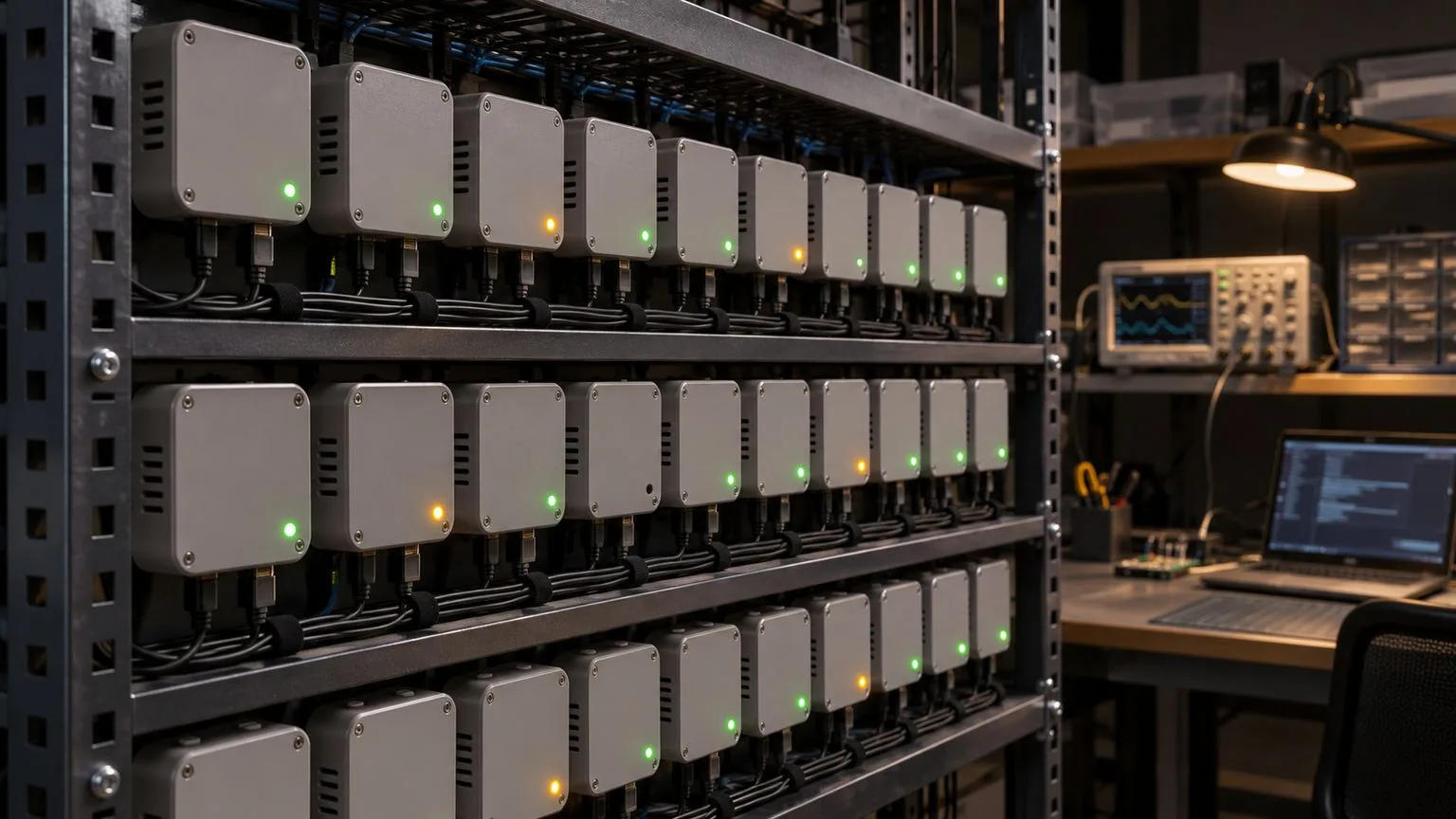
DeviceOps is the operational discipline of keeping physical connected devices identifiable, supportable, updatable and safe throughout their field life. It begins before shipment and continues through daily health monitoring, incident response, repair and decommissioning. The work overlaps with DevOps, but the constraints of hardware, intermittent networks and expensive physical access change what reliable operations look like.
What DeviceOps means
A fleet is not merely a count of online units. Each device has an identity, hardware revision, firmware history, configuration, deployment context and support state. DeviceOps turns those facts into routines: determine what is deployed, decide which cohort receives a change, watch whether the change is healthy, help support diagnose failures, and remove access when a unit leaves service.
That scope complements the design gates in what makes an IoT device production ready. Production readiness asks whether the product can be operated. DeviceOps is the continuing practice of operating it after the first shipment.
Why server DevOps habits break on devices
First, a server is usually reachable through a managed network, while a device may be offline, behind a customer network or awake only briefly. Operators cannot assume an interactive session or immediate command delivery. A device should expose bounded diagnostics and recover without an engineer logging in.
Second, the hardware is heterogeneous over time. A software release that works on the current board may not fit an earlier memory layout, radio or sensor revision. Server capacity can often be replaced centrally; a board installed inside a machine, building or product is costly to reach.
Third, rollout speed is constrained by connectivity and consequence. Devices may check in slowly, and a failed update can remove the very channel needed to fix it. Cohorts and observation windows therefore matter more than simultaneous deployment.
Fourth, physical state persists outside the service. A device can keep acting, buffering data or presenting credentials while the backend considers it offline. Device operations must define safe local behavior, not just service availability. Protocol choices such as MQTT versus HTTP for connected devices matter, but they do not remove these operational differences.
Fleet inventory and identity
The inventory should answer a support question without assembling data from several informal lists. At minimum, bind a stable device identity to its hardware revision, component variants that affect software, bootloader or recovery capability, current firmware version, configuration revision and assigned deployment or customer context. Record lifecycle state separately from connectivity state: manufactured, provisioned, deployed, returned, quarantined, retired.
Treat configuration as versioned operational state. Two units on the same firmware can behave differently because thresholds, feature flags or credentials differ. Record the desired configuration and the last configuration the device confirmed, with a time for that confirmation. The same desired-versus-reported distinction should apply to firmware.
Reconcile the inventory with what devices actually report on a regular schedule. Units that have not checked in for longer than their expected interval, devices reporting a hardware revision the record does not list, and configurations that never reached the confirmed state are all inventory defects. Each one needs an owner and a decision, because a fleet record that drifts from reality makes every later rollout and support case slower and less safe.
Identity must survive ordinary replacement decisions without being casually copied. If a board is replaced inside an enclosure, the procedure should say whether the identity follows the physical product, the security module or the new board. Ambiguity creates duplicate units and misleading history.
Staged rollouts and rollback
A rollout starts with compatibility rules, not a percentage. Exclude hardware that cannot run the artifact and devices whose power or connectivity state makes an update unsafe. Begin with internal or easily recoverable units, then a small field cohort, then broader groups that represent the fleet's hardware and network diversity.
Each stage needs stop conditions decided before release. Examples include boot failure, repeated resets, update failure, loss of a required sensor, abnormal power use or a sharp increase in reconnect attempts. Avoid a single global success rate that can hide a severe failure in one hardware revision. Compare each cohort with an appropriate baseline.
Rollback should be a routine, rehearsed operation. The device needs a previously accepted image or another recovery path, and the team needs authority to pause promotion without negotiating during an incident. ESP32 OTA updates in production shows why signing, health confirmation and recovery belong to the operational design. A rollback decision should preserve the failed version, affected cohort and evidence for later analysis rather than erasing the event.
Health signals and alerting
Collect signals tied to actions. Concrete device signals include reset reason and reboot frequency, battery voltage or power state, free storage, update status, sensor availability, internal temperature where relevant, message backlog and failed authentication or reconnect attempts. Service-side signals can show last contact, command expiry and ingestion errors, but they should not be mistaken for the device's local health.
Bandwidth and energy are budgets. Sample stable values less often, send state changes promptly, and aggregate high-rate measurements on the device when raw detail is unnecessary. A diagnostic snapshot requested for one unit should remain bounded and expire rather than turning into permanent verbose logging.
Alert on conditions with an owner and response. A single missed heartbeat from a sleepy device is usually not an incident; a cohort that stops confirming after an update may be. Use fleet summaries to detect drift, cohort views to detect correlated changes, and per-device detail for investigation. Review alerts that never lead to action, because alert fatigue hides the one signal that does.
Support, RMA and end of life
Support should see the inventory, recent health, update history and configuration without requesting a physical return first. When a unit is returned, preserve its identifiers and capture the observed symptom, deployment conditions and support steps before it is reset. Engineering can then group returns by hardware revision, firmware, supplier lot or failure signature. A return is not only a replacement cost; it is evidence that should influence tests, diagnostics and future releases.
Close the loop with a regular review between support, operations, firmware and hardware teams. Confirmed field failures should create reproducible tests where possible. Unconfirmed cases still reveal where telemetry or procedures were insufficient.
Decommissioning completes DeviceOps. Mark the unit retired, revoke its credentials, stop pending commands and updates, detach customer authorization, and handle stored data according to policy. Confirm that a unit brought online later cannot silently rejoin the fleet. Keep enough history to explain the retirement and any later security question, while avoiding indefinite retention of unnecessary customer data.
A well-run fleet is not one with no failures. It is one in which the team can identify the affected devices, stop a harmful change, recover predictable states, learn from physical returns and close access when service ends.